People shop insurance when something changes
Most people don't wake up wanting to compare auto policies. They shop when a renewal notice shows a big jump, when they buy a house, add a teenage driver or have a baby.
You can't know when that happens on each street. What you can do is make sure your name is the one they remember when it does.
That's why insurance mail works best as a steady drumbeat, not a one-time blast.
The renewal-shock card
Premiums have climbed in a lot of states, and plenty of homeowners opened a renewal this year and winced. That's your opening.
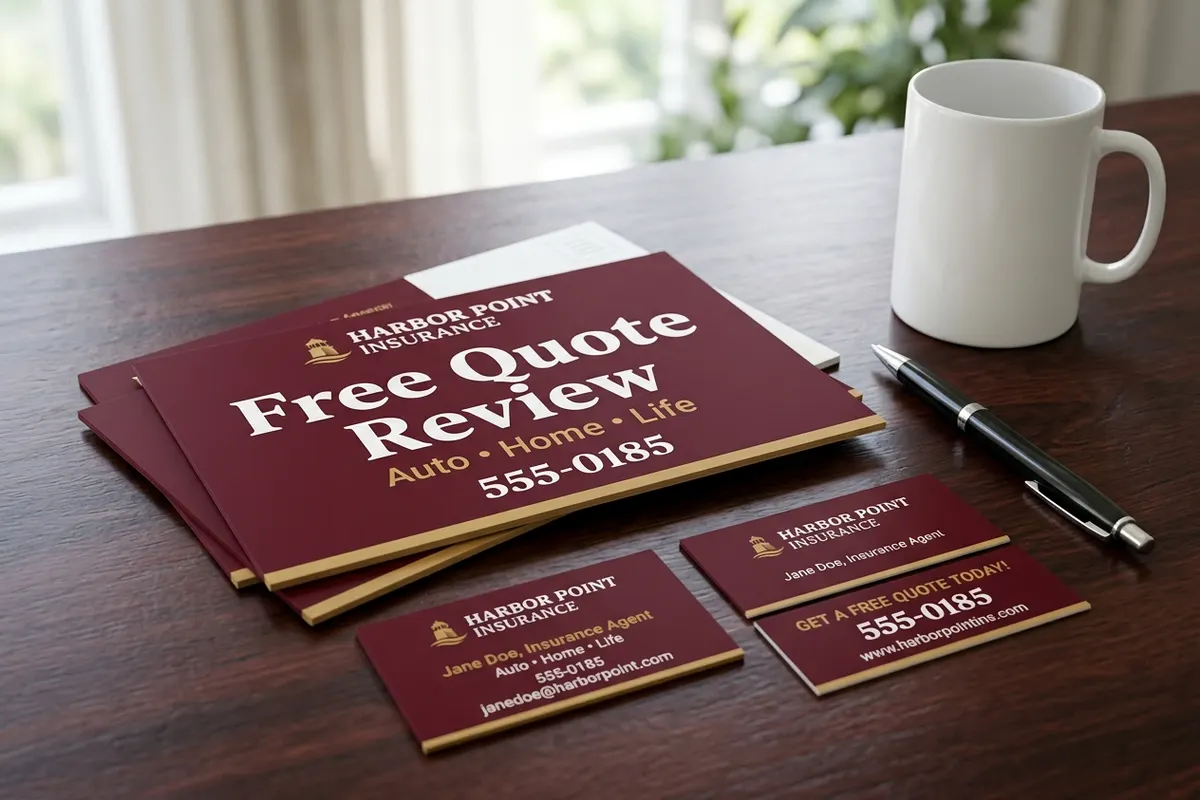
A 6″ × 11″ postcard that says "Did your renewal go up? We'll compare it in 10 minutes" speaks to something they're already annoyed about. Add your photo, your office address and the phone number.
Independent agents can say they shop several companies. That's the real advantage over a single-carrier call center, so put it on the card.
Which routes to pick
Home and auto bundles are the bread and butter for most agencies, so routes with lots of owner-occupied homes are the natural target. The USPS EDDM map shows household counts by carrier route, and you know the neighborhoods better than any data set.
New subdivisions are worth a look. New owners just bought a policy in a rush at closing, and many will shop it at the first renewal.
Stay close to the office. People like an agent they can drop in on, even if they never do.
A brochure for the kitchen-table talk
Some products need more explaining than a postcard allows. Life insurance, umbrella policies, small-business coverage.
An 8.5″ × 11″ tri-fold brochure is the leave-behind for those conversations. One panel per line of coverage, written in plain English, with what each policy protects and who usually needs it.
2,500 cost $399. Keep a stack at the front desk and in your bag for appointments.
Get the carrier's sign-off first
Captive agents usually need their carrier's marketing team to approve anything with the company name or logo on it. Send them the proof before you approve it with us. Nothing prints or gets charged until you click Approve, so there's time.
Independent agents still answer to the state department of insurance on advertising. Avoid naming premium amounts or savings figures you can't back up for every customer.
When in doubt, ask your compliance contact or the state department before the card goes out.
Your book of business is a mailing list
Current clients are the best source of new ones. They have neighbors, coworkers and grown kids who need coverage.
A simple referral card in the annual review packet ("Know someone shopping for insurance? Send them our way") keeps it top of mind. Print them as business cards: 2,500 cost $89.
Cross-selling works the same way. A client with only auto coverage may not know you write homeowners or life.
Small business owners need a call too
The owner of the bakery down the street needs general liability, workers' comp, a policy on the delivery van and maybe coverage for the building. Most of them bought it once and never shopped it again.
A postcard aimed at business addresses on your routes, offering a free quote and policy review, reaches people big online carriers mostly ignore. Keep the message about saving them time, since owners hate paperwork more than they hate premiums.
One commercial account can be worth several personal lines policies, and it often brings the owner's home and auto with it.
How often to mail
Every four to six weeks to the same set of routes is a good rhythm. It's often enough to be remembered and spaced out enough not to annoy.
Rotate the message. Renewal-shock in one drop, bundling home and auto in the next, then life insurance, then a local or seasonal note like storm season or a new-driver reminder in the spring.
Track calls by giving each card its own phone extension or a line like "mention this card." After a few months you'll know which messages ring the phone.
Pricing a year of agency mail
10,000 6″ × 11″ postcards ($949), 2,500 brochures ($399) and 2,500 business cards ($89) come to $1,437 in printing.
EDDM postage is paid separately to USPS. Put the current rate into the EDDM cost calculator to see the full spend per drop.
Design is $89 for the postcard. Call 512-573-1977 and we'll help you pick routes near the office and price the year.
Prices from our current price list. Content reviewed November 21, 2026.